
Surveying Eco-functioning And Creating Resilient Eco-Shorelines for Tomorrow (SEACREST)
This project aims to establish an effective monitoring regime and evidence-based guidance for designing resilient hybrid shorelines and restoring their baseline coastal-protection potential after extreme events.
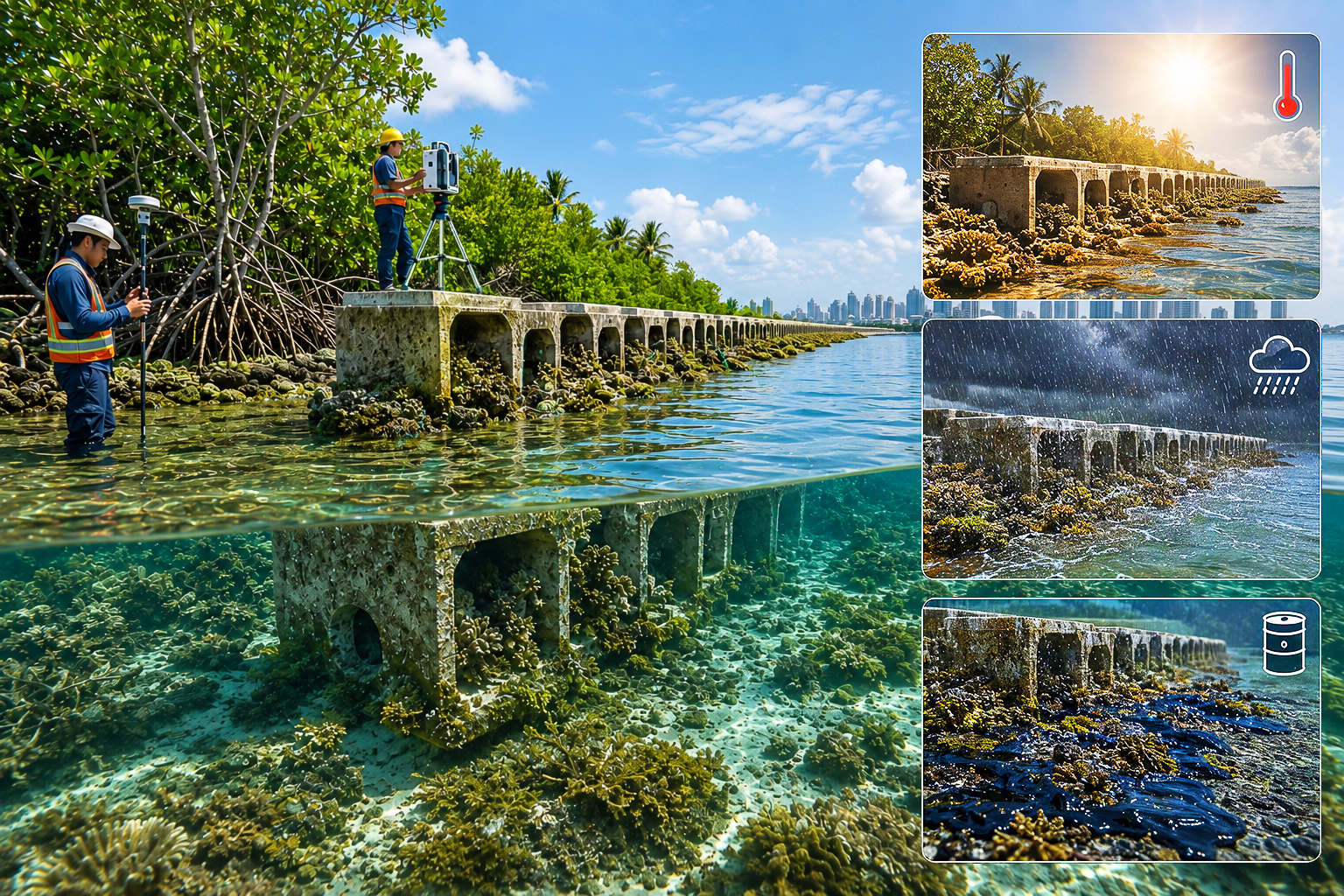
Hybrid shorelines combine engineered structures with living components such as mangroves or corals. These green elements can dissipate wave energy and trap sediment, but their protective contribution depends on their health. Tropical monitoring metrics remain underdeveloped, while heatwaves, heavy rainfall and oil spills can damage habitat-forming species. Agencies also lack clear protocols for restoring protective function after such events.
Research Approach
- Photogrammetry, laser scanning and modelling will track the
biological and physical parameters that underpin coastal protection. - Experiments will quantify how high temperatures, heavy
rainfall and oil affect nature-based components and their ability to protect shorelines under present and future climate conditions. - The research will identify impact-resilient shoreline designs and develop a structured protocol for selecting and implementing remedial measures after disturbance.
Why This Matters
- Helps agencies determine what to monitor and how to assess the condition of tropical hybrid shorelines.
- Detects when ecological damage may be weakening coastal-protection performance.
- Guides timely, evidence-based remedial action following climate-driven or human-caused disturbances.
- Integrates ecological evidence with engineering design to support durable green-grey coastal protection.
Meet the Team
Meet the team behind the Surveying Eco-functioning And Creating Resilient Eco-Shorelines for Tomorrow (SEACREST) project.
Principal Investigator (PI):
Associate Professor Peter Todd
National University of Singapore,
Department of Biological Sciences,
Faculty of Science
Download CFI's project booklet for more information on each project
CFI Singapore Tranche 1 and 2
If you wish to reach out regarding a specific project, please email CFI Singapore at cfisg@nus.edu.sg